Loading page
Loading…
Loading…
A platform for coordinating hospital operations (admissions, departments, staff, and records) with an emphasis on auditability and reliable data across teams.
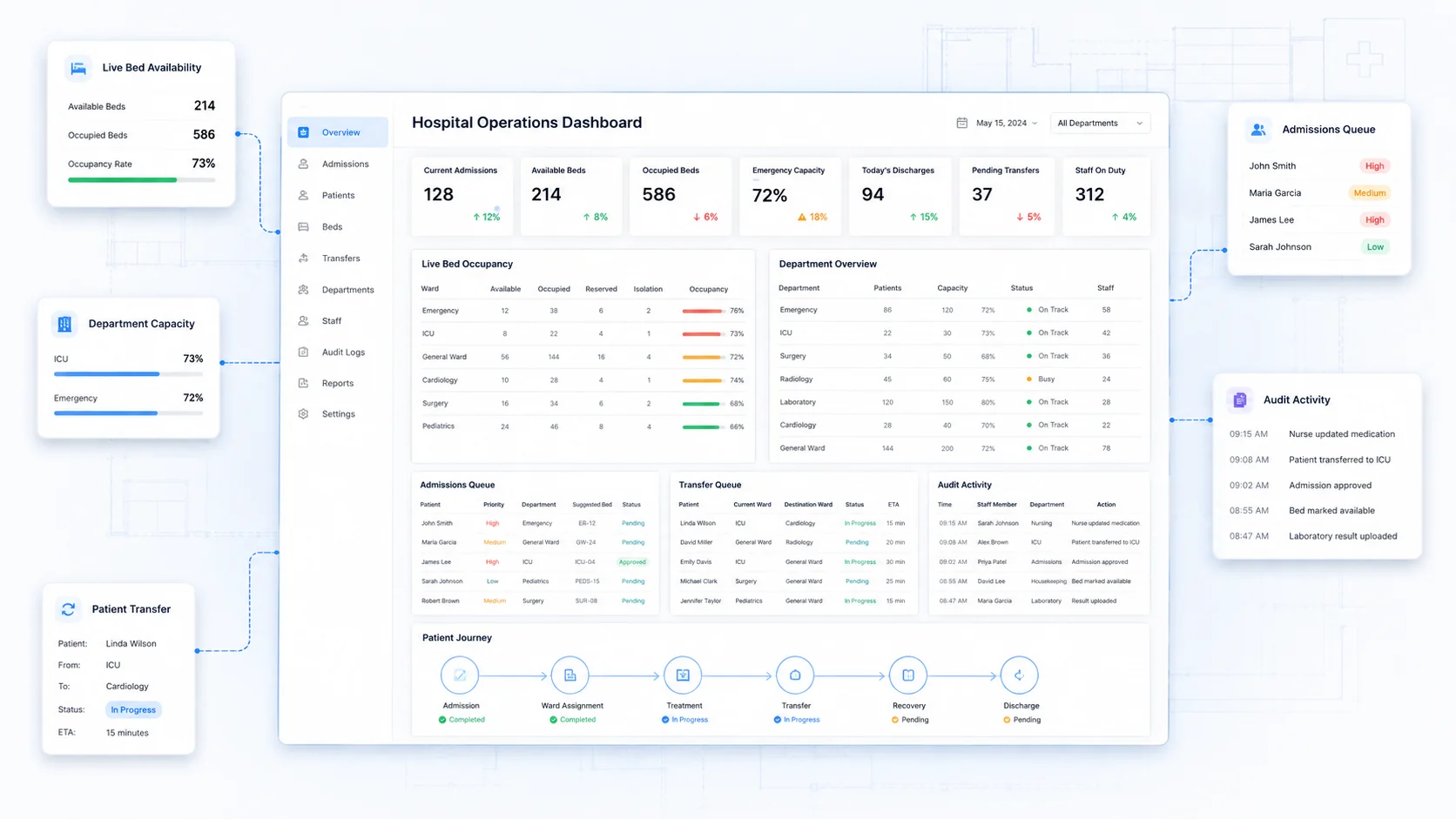
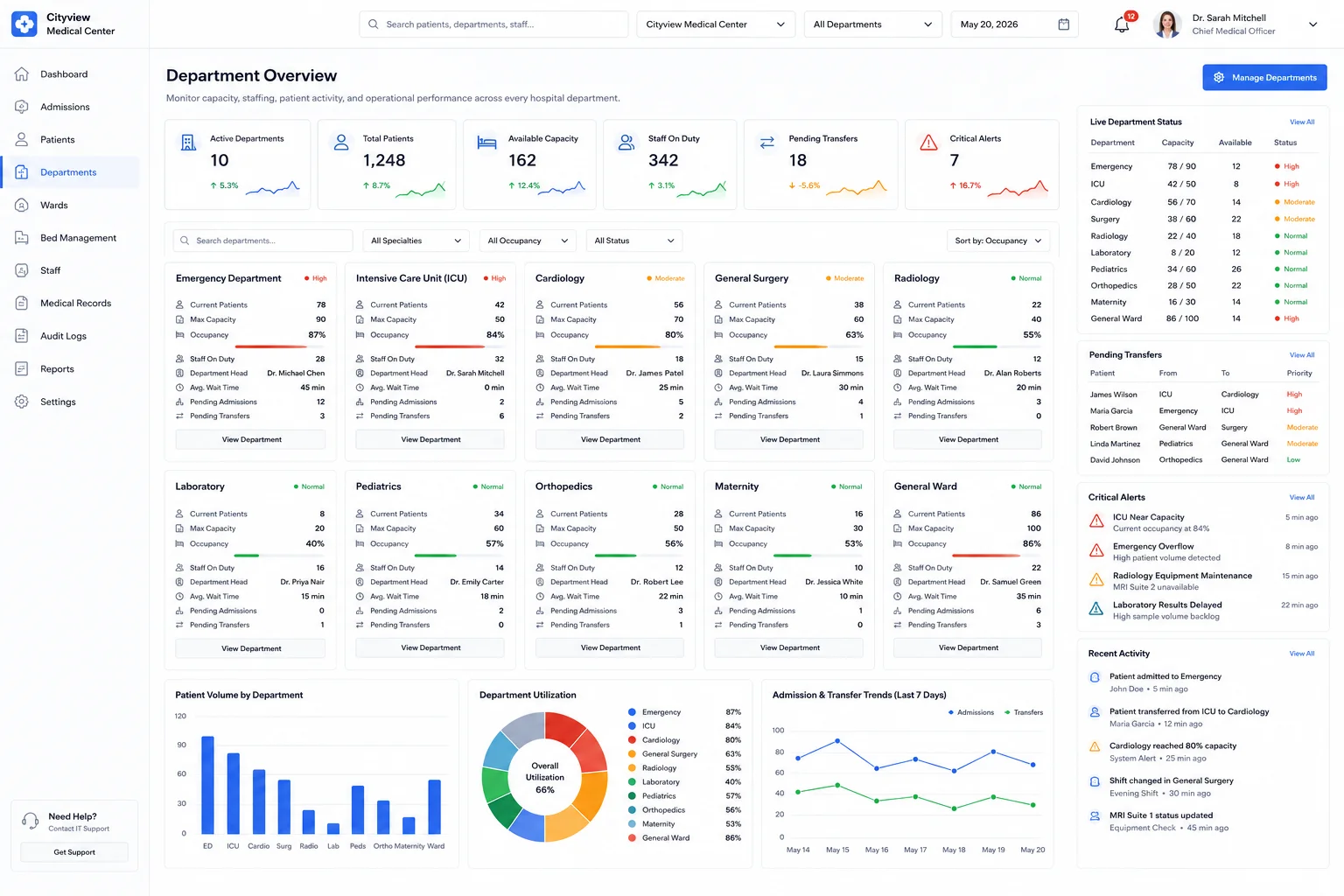
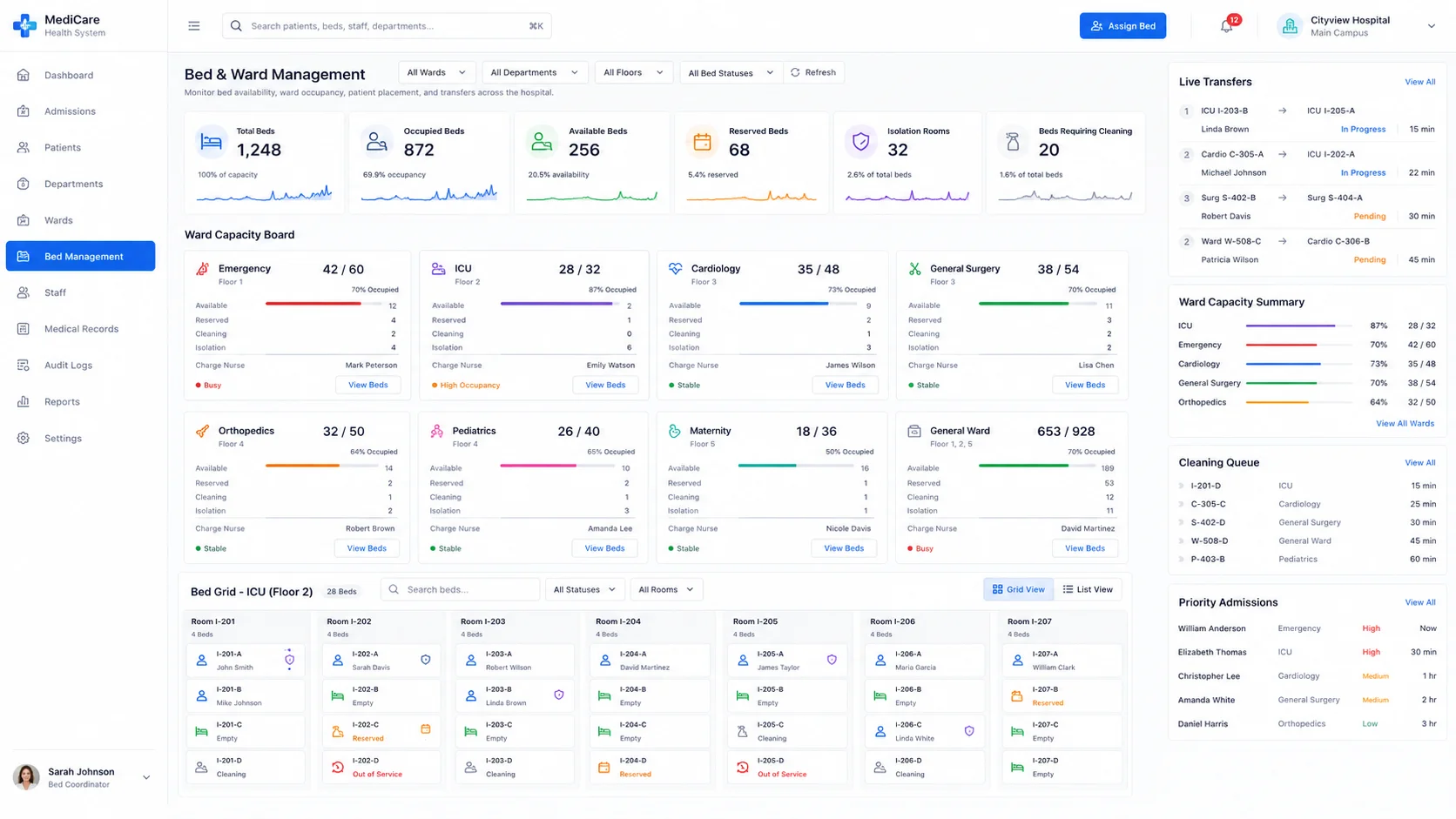
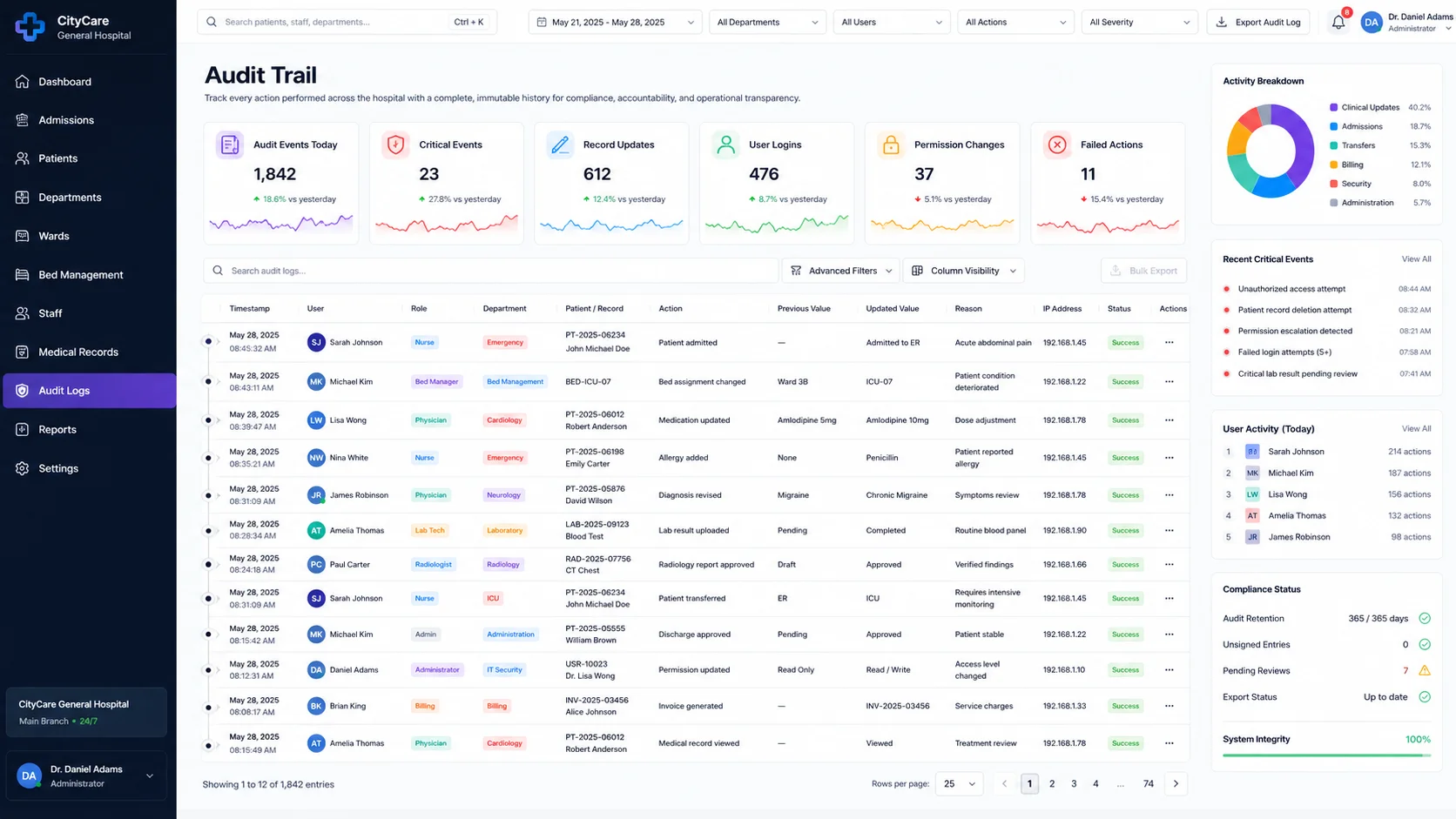
A multi-department platform that coordinates hospital operations from admission through discharge. Wards, clinical staff, and administrators share a single patient identity and a common set of records, while each department retains a workspace tuned to its own workflow. Sensitive actions are captured in an audit trail so responsibility for every change is traceable.
Larger facilities span dozens of departments, each with its own staff, roles, and record-keeping habits. Without a shared system, a single patient accumulates fragments of information across admissions, wards, and clinics that never join up. Coordination breaks down at the seams: beds are double-allocated, transfers lose context, and there is no reliable audit of who changed what, when.
Workflow analysis focused on the transitions between departments (admission to ward, ward to ward, ward to discharge), since these hand-offs are where inpatient information is most often lost. The study confirmed that the unit of coordination is the patient's journey through the facility, not any single department's view, which drove the decision to make patient identity and the record shared while keeping the surrounding workflows modular.
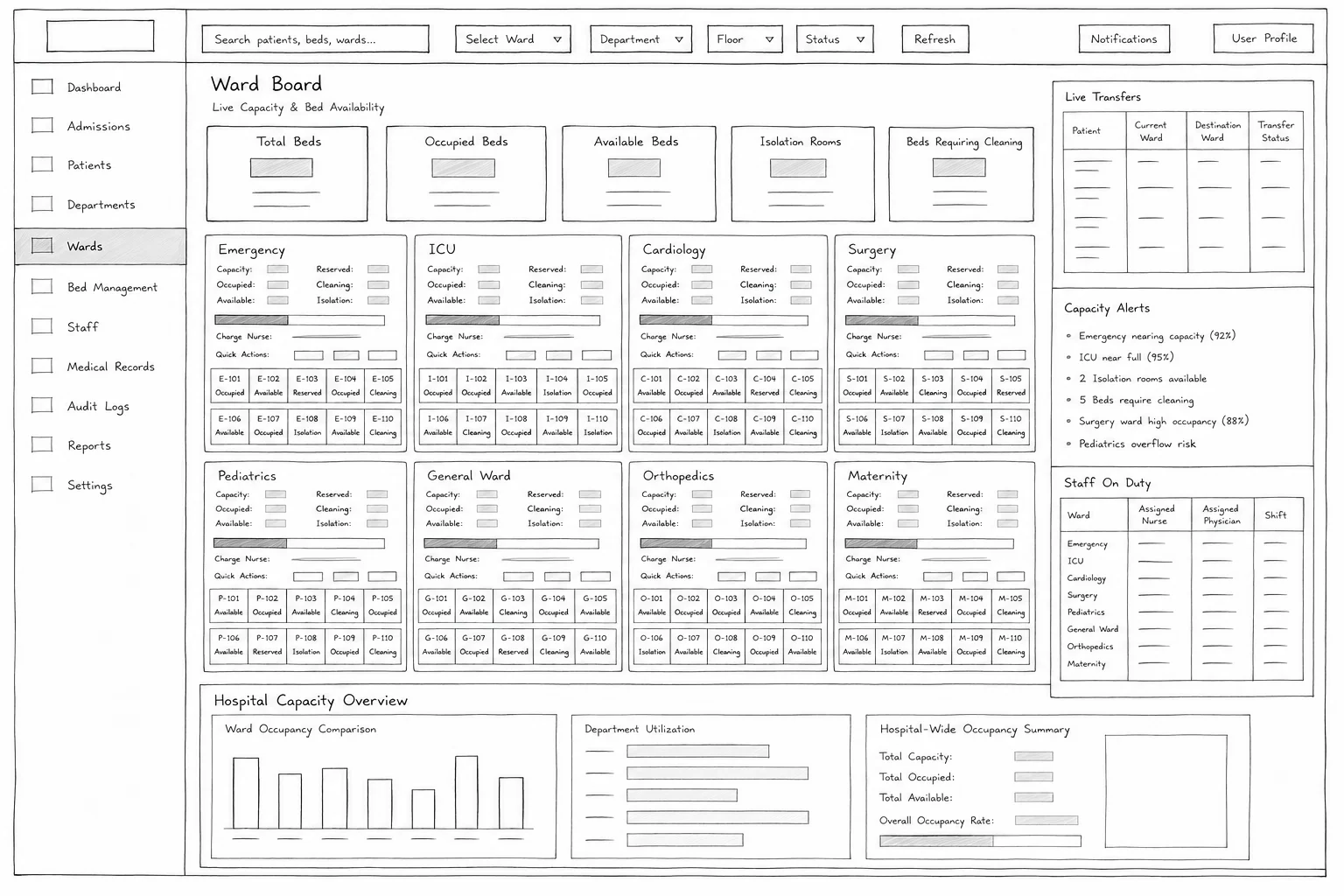
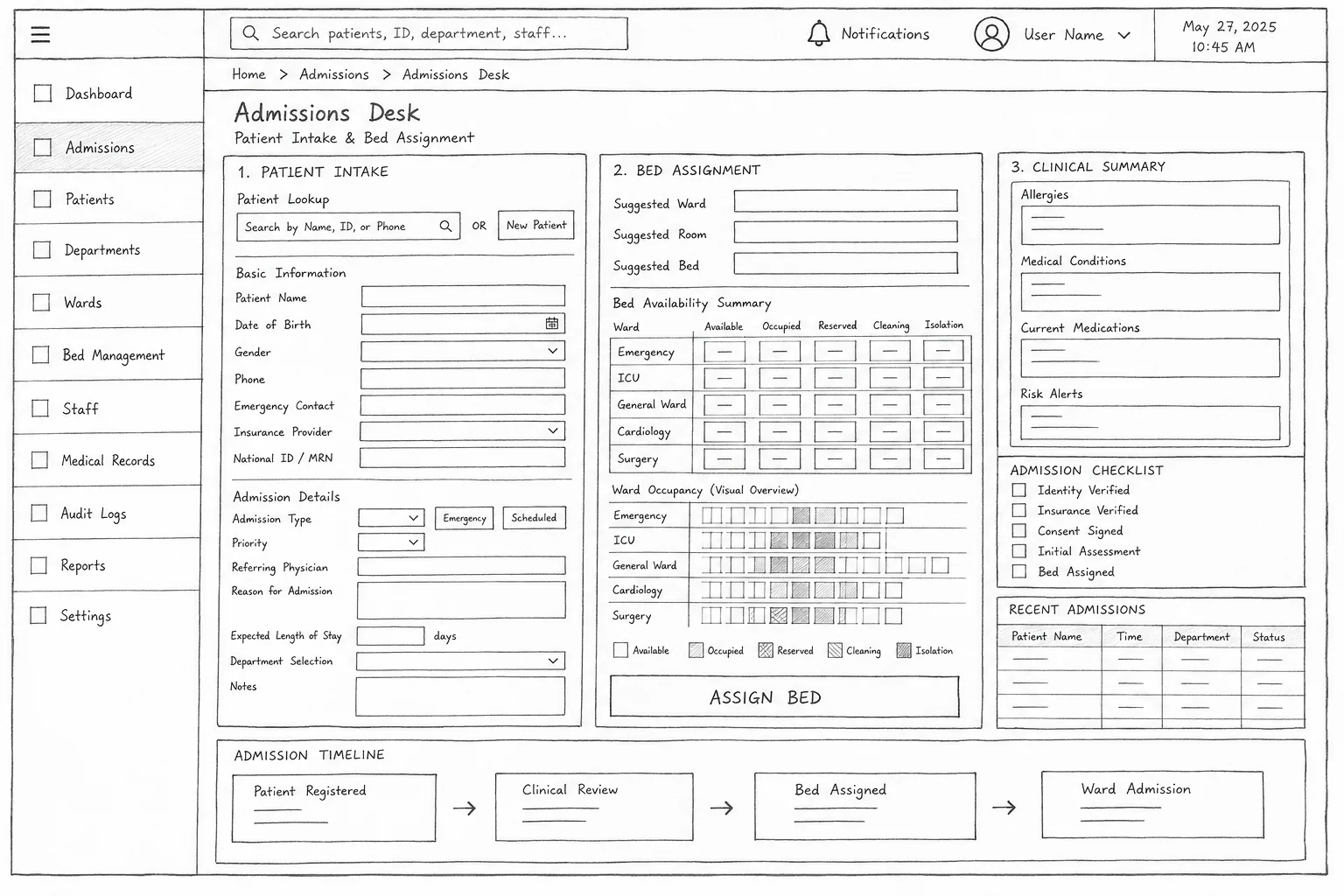
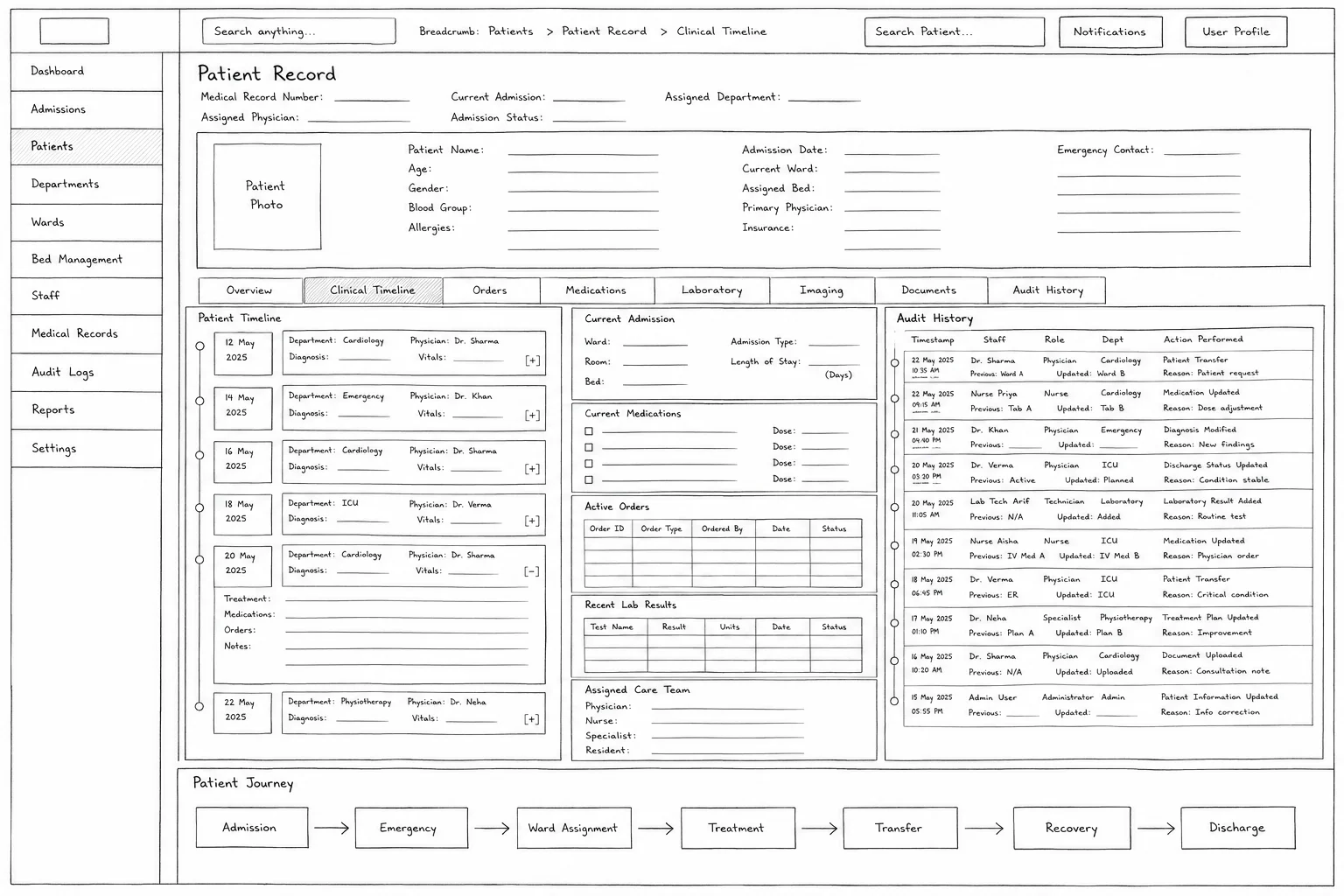
Core entities are Patient, Admission, Ward, Bed, Department, Staff (User), and AuditLog. A Patient has many Admissions; each Admission references a current Bed within a Ward, and Beds belong to Wards which belong to Departments. Staff are linked to Departments through role assignments. Clinical activity (Orders, Notes) attaches to an Admission rather than directly to the Patient, preserving the context of each episode. Every mutation on sensitive tables writes an AuditLog row capturing the actor, action, entity, and timestamp.
A REST API partitioned by domain: /api/admissions, /api/wards, /api/beds, /api/departments, and /api/staff, with transfer and discharge modeled as explicit state-changing endpoints (e.g. POST /api/admissions/:id/transfer) rather than raw field updates. This keeps clinical state transitions validated and auditable. Authentication is token-based, and authorization is scoped both by role and by department so staff only reach the modules they belong to.
A Next.js frontend where each department module is a route segment composed from shared UI primitives, so a ward board, an admissions desk, and an admin console feel consistent while serving different tasks. Server components render record and capacity data; client components handle the interactive bed board and transfer flows. Cross-cutting concerns like the patient header and audit panel are shared components reused across modules.
A Node.js and Express.js backend structured as domain services (admissions, capacity, staffing) over PostgreSQL. State transitions run inside database transactions so a transfer atomically frees one bed and reserves another. An audit-logging concern is applied as a service-layer wrapper, guaranteeing that sensitive writes and their log entries commit together.
Links will be added when the project is published.
Get in touch
We'd be glad to discuss how a solution like this could fit your organization.